
The Government
The Council of Households, the ministerial cabinet of the People's Republic of Fiakistan, collectively carries the nation's pro-natalist policy.

A graduate of the National School of Household Administration ("Golden Cradle" class of 1994), Gabriel Moreau rose through the ranks of the Mont-Jumeau prefecture before taking the helm of Government in 2011. Renowned for never having left a single spelling mistake in an official circular, he coined the founding phrase "one household, two mounds" and personally presides over the New Households Reception every other Wednesday. Married three times, he happily explains that his fourth marriage, planned for next year, answers "a statistical imperative more than an impulse of the heart".

A former commissioner of the Border Police, Isabelle Costa headed the One-Stop Office of Good Will before her appointment in 2015. She holds the national record for marriages celebrated in a single evening (eleven, on a December Wednesday still famous in the municipal archives) and can recite from memory the anniversary date of every registered household on the territory. She has made the compulsory presence of a flowering mound in front of every town hall a priority of her term.
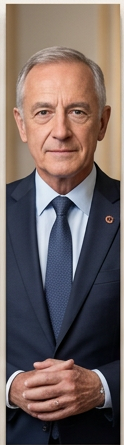
A career officer trained at the Academy of the Two Mounds, Bernard Dubois commanded the Honour Guard before taking the Defence portfolio in 2017. A theorist of "deterrence by brass band", he personally oversaw the addition of brass and percussion to the national anthem, on the grounds that "a country that cannot march cannot defend itself". He once delayed a military parade by forty minutes because a couple attending the ceremony had just announced an imminent birth.
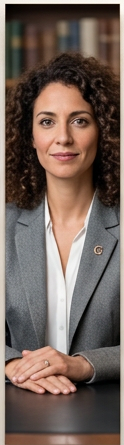
Top graduate of the Higher Institute of Domestic Economics, Camille Laurent designed the Cradle Tax Credit, which indexes tax brackets to the number of children in a household. Though childless herself so far, she drives a family estate car bought "on principle and to set an example", which she stubbornly refuses to sell. She keeps, in a spreadsheet she herself calls "obsessive", a ten-year birth-rate forecast for the territory.

A former obstetrician at the territory's only hospital, Thomas Girard joined the Government in 2019 after personally delivering, by his own count, "a little over a sixth of the national population". He continues to sign every official birth certificate by hand, a practice his staff consider unsustainable but which he refuses to give up. His favourite saying, since engraved on the Ministry's pediment: "Every cradle is a matter of State."

Former head of the country's only school, Nathalie Leroy introduced a "Family Civics" course into the curriculum, compulsory from age six. She made learning the first three bars of the national anthem mandatory from kindergarten, on the grounds that "you cannot build a nation without knowing how to hum it". She personally grades, every year, the greeting letters schoolchildren send to the Presidency.
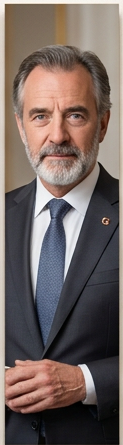
A trained magistrate, Pierre Renault authored the Code of Prolonged Engagements, which recognises an intermediate legal status between single life and marriage for couples "still weighing things up". Renowned for his procedural exactness, he is said to have sent back a naturalisation file three times over a misplaced comma. He chairs, on a voluntary basis, the committee responsible for verifying the accuracy of file numbers issued by the Office of Pro-Natalist Naturalisation.

A career diplomat who has held posts in Brussels, Luxembourg and Paris, Claire Vasseur negotiated the Mont-Jumeau Declaration that now governs Fiakistan's relations with its neighbours. She practises what she calls "reception diplomacy", convinced that no border dispute can withstand a shared drink on a Wednesday evening. She keeps in her office a map of Europe on which the national territory has been, ruler in hand, slightly enlarged.